The bootstrap has other uses than those described in the last chapter.
In particular, it allows us to design ensemble methods in statistical learning.
Bagging (Bootstrap Aggregating), which is the most famous approach in this direction, can be applied to both regression and classification.
Below, we mainly focus on bagging of classification trees, but it should be clear that bagging of regression trees can be performed similarly.
2 Reminders on classification
2.1 The classification problem
In classification, one observes \((X_i,Y_i)\), \(i=1,\ldots,n\), where
\(X_i\) collects the values of \(p\) predictors on individual \(i\), and
\(Y_i\)\(\in\{1,2,\ldots,K\}\) is the class to which individual \(i\) belongs.
The problem is to classify a new observation for which we only see \(x\), that is, to bet on the corresponding value \(y \in \{1,2,\ldots,K\}\).
A classifier is a mapping \[\begin{eqnarray*}
\phi_{\mathcal{S}}:
\mathcal{X} & \to & \{1,2,\ldots,K\} \\[2mm]
x & \mapsto & \phi_{\mathcal{S}}(x),
\end{eqnarray*}\] that is designed using the sample \(\mathcal{S}=\{(X_i,Y_i), \ i=1,\ldots,n\}\).
2.2 Data set on a retirement centre
2.2.1 Description
The channing data set has 462 observations and 4 variables.
This data frame contains the following columns:
sex: A factor for the sex of each resident (“Male” or “Female”).
entry: The residents age (in months) on entry to the centre
time: The length of time (in months) that the resident spent at Channing House. (time=exit-entry)
cens: The indicator of right censoring. 0 indicates that the resident died at Channing House, 1 indicates that they left the house prior to July 1, 1975 or that they were still alive and living in the centre at that date.
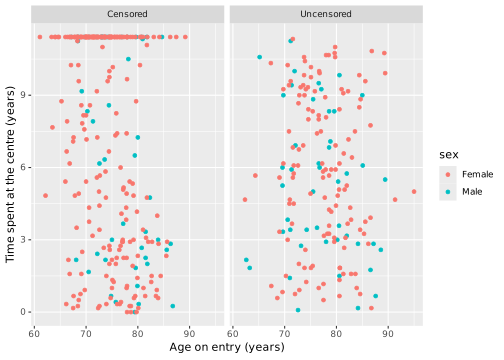
Goal: Predict sex\(\in \{\text{Male}, \text{Female} \}\) on the basis of two numerical predictors (entry, time) and a binary one (cens).
Code
library(ggplot2)ggplot(channing, aes(entry/12, time/12, color = sex)) +geom_point() +facet_wrap(vars(ifelse(cens ==1, "Censored", "Uncensored"))) +labs(x ="Age on entry (years)", y ="Time spent at the centre (years)")
Figure 1: Scatter plot of the channing data set.
2.3 Classification trees
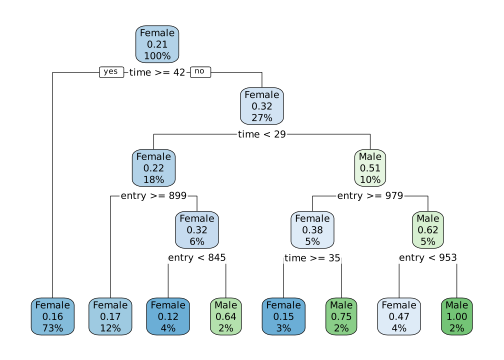
In Chapter 3 of this course, we learned about a special type of classifiers \(\phi_{\mathcal{S}}\), namely classification trees (Breiman et al. 1984).
Code
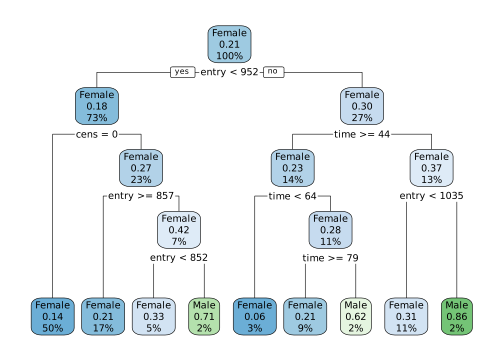
library(rpart)library(rpart.plot)fitted.tree <-rpart(sex ~ ., data = channing, method ="class")rpart.plot(fitted.tree)
The process of averaging will reduce variability, hence, improve stability. Recall indeed that, if \(U_1,\ldots,U_n\) are uncorrelated with variance \(\sigma^2\), then \[
\text{Var}[\bar{U}]=\frac{\sigma^2}{n}
\cdot
\] Since unpruned trees have low bias (but high variance), this reduced variance will lead to a low value of \[
\text{MSE}=\text{Var}+(\text{Bias})^2
\] which will ensure a good performance.
How to perform this averaging?
3 Bagging of classification trees
3.1 Bagging
Denote as \(\phi_{\mathcal{S}}(x)\) the predicted class for predictor value \(x\) returned by the classification tree associated with sample \(\mathcal{S}=\{(X_i,Y_i), \ i=1,\ldots,n\}\).
Bagging of this tree considers predictions from \(B\) bootstrap samples \[\begin{matrix}
\mathcal{S}^{*1} &=& ((X_1^{*1},Y_1^{*1}), \ldots, (X_n^{*1},Y_n^{*1})) & \leadsto & \phi_{\mathcal{S}^{*1}}(x) \\
\vdots & & & & \vdots \\
\mathcal{S}^{*b} &=& ((X_1^{*b},Y_1^{*b}), \ldots, (X_n^{*b},Y_n^{*b})) & \leadsto & \phi_{\mathcal{S}^{*b}}(x) \\
\vdots & & & & \vdots \\
\mathcal{S}^{*B} &=& ((X_1^{*B},Y_1^{*B}), \ldots, (X_n^{*B},Y_n^{*B})) & \leadsto & \phi_{\mathcal{S}^{*B}}(x) \\
\end{matrix}\] then proceeds by majority voting (i.e., the most frequently predicted class wins): \[
\phi_{\mathcal{S}}^\text{Bagging}(x)
= \underset{k \in \{1, \ldots, K\}}{\operatorname{argmax}} \# \{ b:\phi_{\mathcal{S}^{*b}}(x)=k \}
\]
Figure 2: Classification tree from the first bootstrap sample.
Code
channing[1, 2:4]
entry
time
cens
782
127
0
Code
predict(fitted.tree, channing[1, ],type ="class")
   1
Male
Levels: Female Male
3.2.2 Bootstrap sample n°2
Code
d <-sample(1:n, replace =TRUE)fitted.tree <-rpart(sex ~ ., data = channing[d, ], method ="class")rpart.plot(fitted.tree)
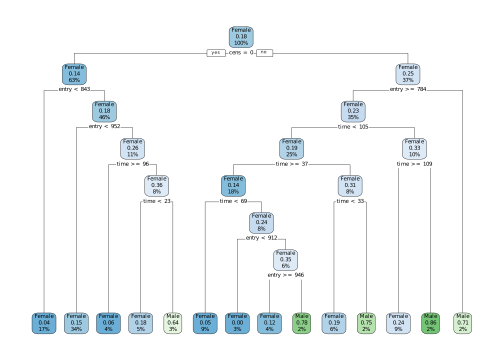
Figure 3: Classification tree from the second bootstrap sample.
Code
channing[1, 2:4]
entry
time
cens
782
127
0
Code
predict(fitted.tree, channing[1, ],type ="class")
   1
Male
Levels: Female Male
3.2.3 Bootstrap sample n°3
Code
d <-sample(1:n, replace =TRUE)fitted.tree <-rpart(sex ~ ., data = channing[d, ], method ="class")rpart.plot(fitted.tree)
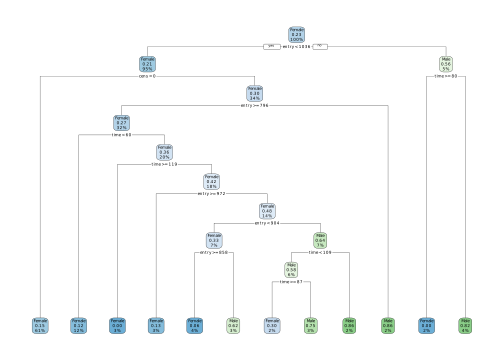
Figure 4: Classification tree from the third bootstrap sample.
Code
channing[1, 2:4]
entry
time
cens
782
127
0
Code
predict(fitted.tree, channing[1, ],type ="class")
     1
Female
Levels: Female Male
3.2.4 Aggregation of the classifiers
For \(x=\,\)(entry, time, cens)\(\,= (782, 127, 1)\),
two (out of the \(B=3\) trees) voted for Male
one (out of the \(B=3\) trees) voted for Female,
the bagging classifier will thus classify \(x\) into Male.
Of course, \(B\) is usually much larger (\(B=500\)? \(B=1000\)?), which requires automating the process (through, e.g., the boot function).
3.3 Bagging vs. CART
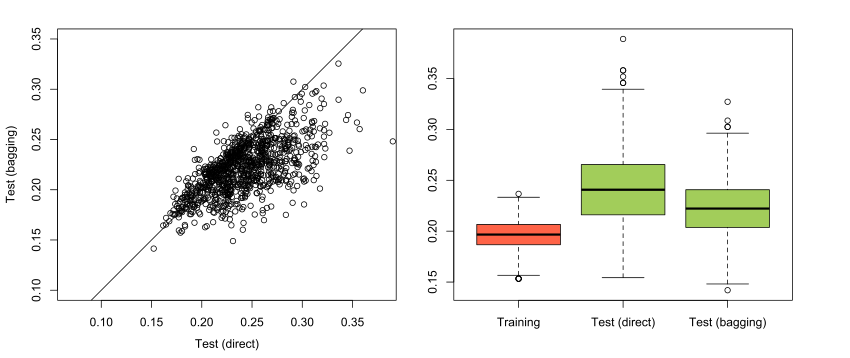
We repeat \(M=1000\) times the following experiment:
Split the data set into a training set (of size 300) and a test set (of size 162);
train a classification tree on the training set and evaluate its test error (i.e., misclassification rate) on the test set;
do the same with a bagging classifier using \(B=500\) trees.
This provides \(M=1000\) test errors for the direct (single-tree) approach, and \(M=1000\) test errors for the bagging approach.
Figure 5: Results of the simulation (Q-Q plot and boxplot).
4 Estimating the prediction accuracy
Several strategies to estimate prediction accuracy of a classifier:
(1) Compute a test error (as above): Partition the data set \(\mathcal{S}\) into a training set \(\mathcal{S}_\text{train}\) (to train the classifier) and a test set \(\mathcal{S}_\text{test}\) (on which to evaluate the misclassification rate \(e_\text{test}\)).
(2) Compute an \(L\)-fold cross-validation error:
Partition the data set \(\mathcal{S}\) into \(L\) folds \(\mathcal{S}_{\ell}\), \(\ell=1,\ldots,L\). For each \(\ell\), evaluate the test error \(e_{\text{test},\ell}\) associated with training set \(\mathcal{S}\setminus\mathcal{S}_{\ell}\) and test set \(\mathcal{S}_{\ell}\).
Table 1: \(L\)-fold cross-validation framework.
Fold 1
Fold 2
Fold 3
Fold 4
Fold 5
Run \(\ell\)=1
Test
Train
Train
Train
Train
Run \(\ell\)=2
Train
Test
Train
Train
Train
Run \(\ell\)=3
Train
Train
Test
Train
Train
Run \(\ell\)=4
Train
Train
Train
Test
Train
Run \(\ell\)=5
Train
Train
Train
Train
Test
Then the (\(L\)-fold) ‘cross-validation error’ is: \[
e_\text{CV}=\frac{1}{L}\sum_{\ell=1}^L e_{\text{test},\ell}
\]
For each observation \(X_i\) from \(\mathcal{S}\), define the OOB prediction as \[
\phi_{\mathcal{S}}^\text{OOB}(X_i)
= \underset{k\in\{1,\ldots,K\}}{\operatorname{argmax}} \# \{ b:\phi_{\mathcal{S}^{*b}}(X_i)=k
\textrm{ and } (X_i,Y_i)\notin \mathcal{S}^{*b} \}
\] This is a majority voting discarding, quite naturally, bootstrap samples that use \((X_i,Y_i)\) to train the classification tree. The OOB error is then the corresponding misclassification rate \[
e_\text{OOB}=\frac{1}{n}\sum_{i=1}^n
\mathbb{1}[ \phi_{\mathcal{S}}^\text{OOB}(X_i) \neq Y_i]
\]
5 Final remarks
Bagging of trees can also be used for regression. The only difference is that majority voting is then replaced with an averaging of individual predicted responses.
Bagging is a general device that applies to other types of classifiers. In particular, it can be applied to \(k\)-NN classifiers (we will illustrate this in the practical sessions).
Bagging affects interpretability of classification trees. There are, however, solutions that intend to measure importance of the various predictors (see the next section).
Breiman, Leo, Jerome H. Friedman, Richard A. Olshen, and Charles J. Stone. 1984. Classification AndRegressionTrees. 1st ed. Routledge. https://doi.org/10.1201/9781315139470.