Case Study in R: Recruitment agency

Last updated on January 19, 2026

1 About trees

1.1 Introduction

Applications

  1. Predict the land use of a given area (agriculture, forest, etc.) given satellite information, meteorological data, socio-economic information, prices information, etc.
  2. Determine how computer performance is related to a number of variables which describe the features of a PC (the size of the cache, the cycle time of the computer, the memory size and the number of channels. Both the last two were not measured but minimum and maximum values obtained).

Risk of heart attack

Predict high risk for heart attack:

  • University of California: a study into patients after admission for a heart attack.
  • 19 variables collected during the first 24 hours for 215 patients (for those who survived the 24 hours)
  • Question: Can the high risk (will not survive 30 days) patients be identified?
heart_tree N0 Is the minimum systolic blood pressure over the initial 24-hour period > 91? N1 Is the age > 62.5? N0->N1 yes N2 High N0->N2 no N3 Is sinus tachycardia present? N1->N3 yes N4 Low N1->N4 no N7 High N3->N7 yes N8 Low N3->N8 no
Figure 1: A binary tree to identify patients at high risk of heart attack. Source: (Breiman et al. 1984, fig. 1.1).

A recruiting agency

Code
# Data
candidates <- read.csv("data/recruitment.csv", row.names = 1)
# Transformation of the variable to predict into a factor
candidates$Res <- as.factor(candidates$Res)
candidates
Table 1: Data set on candidates for a job.
Id Dip Test Exp Res
A 1 5 4 0
B 2 3 3 0
C 1 4 5 1
D 2 3 4 0
E 1 4 4 0
F 4 3 4 1
G 3 4 4 1
H 1 1 5 0
I 3 2 5 1
J 5 4 4 1
Code
# Classification tree
library(rpart)
library(rpart.plot)

# Building the tree (prune is not useful here)
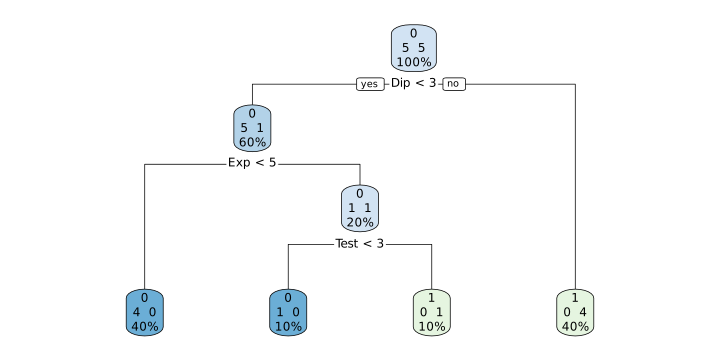
candidates_fit <- rpart(Res ~ Dip + Test + Exp,
  data = candidates, method = "class",
  parms = list(split = "gini"), control = rpart.control(minsplit = 2)
)
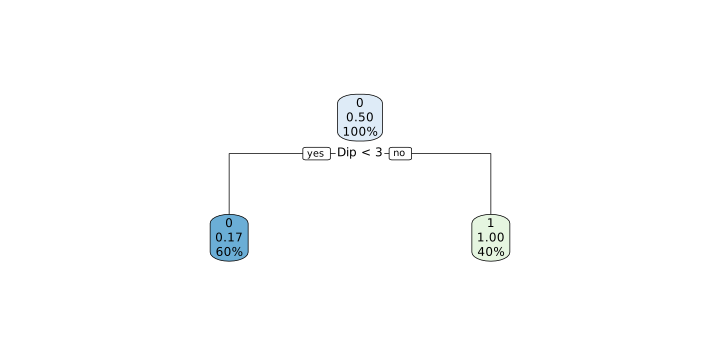
rpart.plot(candidates_fit, extra = 101)

1.2 Full binary trees

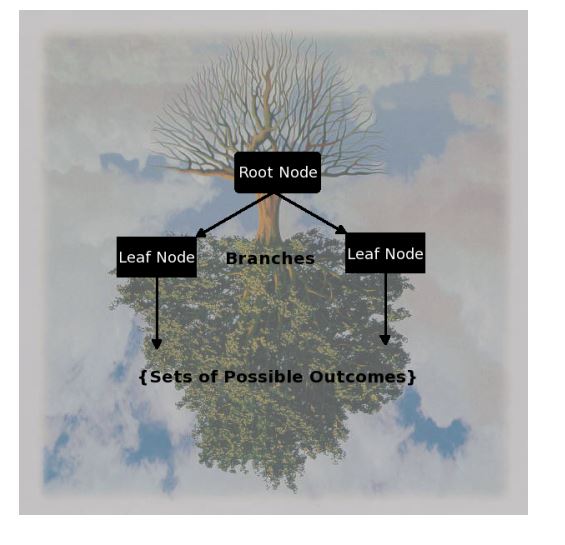
Figure 2: A (reversed) true tree.

1.3 When to use decision trees?

2 Procedure

2.1 Overview

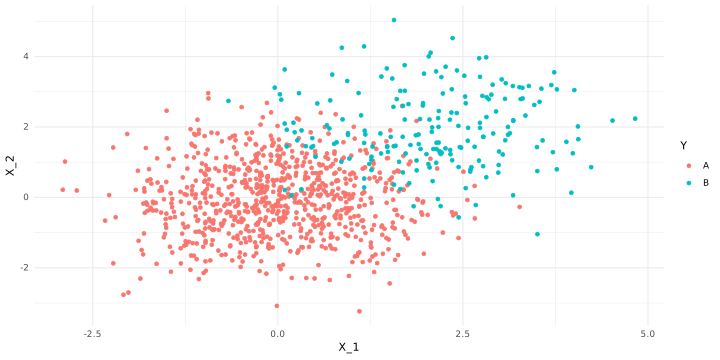
A synthetic 2D example

Code
library(ggplot2)
set.seed(0)

a <- data.frame(X_1 = rnorm(800), X_2 = rnorm(800), Y = as.factor("A"))
b <- data.frame(X_1 = rnorm(200, 2), X_2 = rnorm(200, 2), Y = as.factor("B"))
ab <- rbind(a, b)

ggplot(ab, aes(X_1, X_2, color = Y, label = Y)) +
  geom_point()
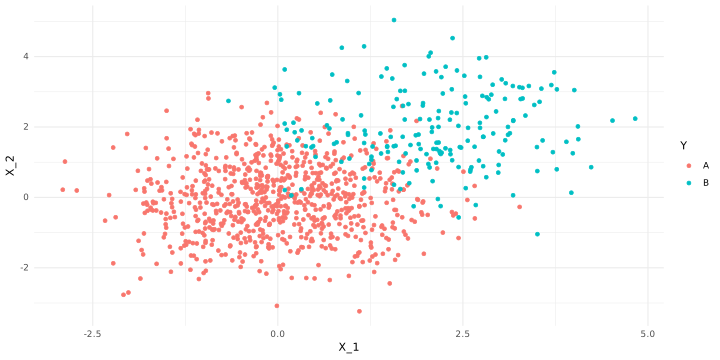
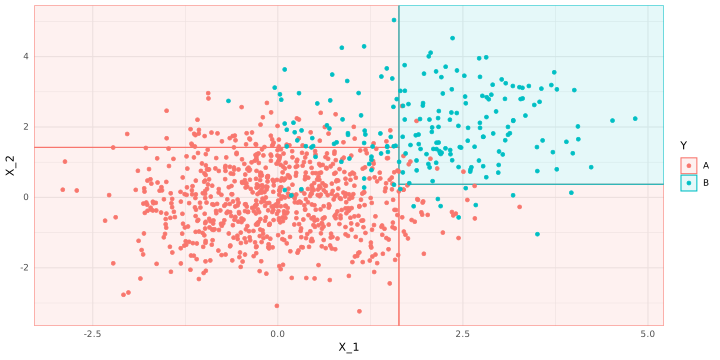
Figure 3: A two-classes variable to predict with two quantitative predictors \(X_1\) and \(X_2\).

2.2 Recursive partitioning

Depth 0

Code
library(rpart)
library(rpart.plot)
library(parttree)

ab_fit <- rpart(Y ~ ., data = ab, minbucket = nrow(ab), cp = 0)
rpart.plot(ab_fit, box.palette = "RdBu")

ggplot(ab, aes(X_1, X_2, color = Y, label = Y)) +
  geom_point()
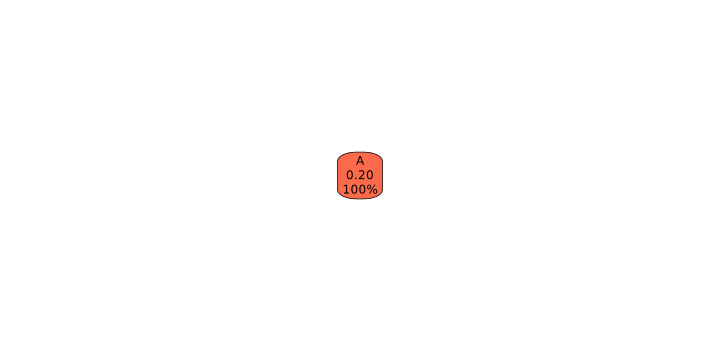
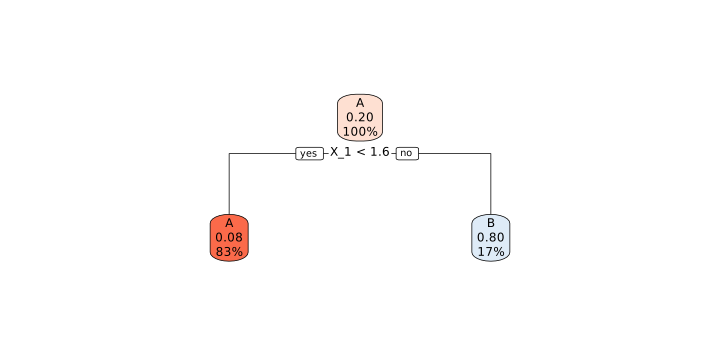
(a) Depth 0: a root node.
(b) Depth 0: the feature space.
Figure 4: Building splits recursively.

Depth 1

Code
depth = 1
ab_fit <- rpart(Y ~ ., data = ab, maxdepth = depth, cp = -Inf)

rpart.plot(ab_fit, box.palette = "RdBu")

p <- ggplot(ab, aes(X_1, X_2, color = Y, fill = Y)) +
  geom_parttree(data = ab_fit, alpha = 0.1, flip = depth == 1) +
  geom_point()
print(p)
(a) Depth 1: the first split.
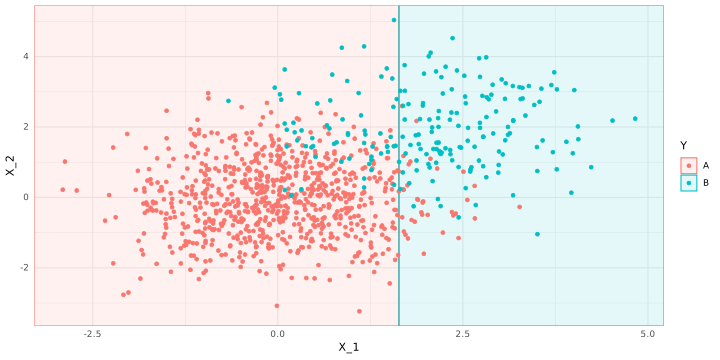
(b) Depth 1: partitioning the feature space.
Figure 5: Building splits recursively.

Depth 2

Code
depth = 2
ab_fit <- rpart(Y ~ ., data = ab, maxdepth = depth, cp = -Inf)

rpart.plot(ab_fit, box.palette = "RdBu")

p <- ggplot(ab, aes(X_1, X_2, color = Y, fill = Y)) +
  geom_parttree(data = ab_fit, alpha = 0.1, flip = depth == 1) +
  geom_point()
print(p)
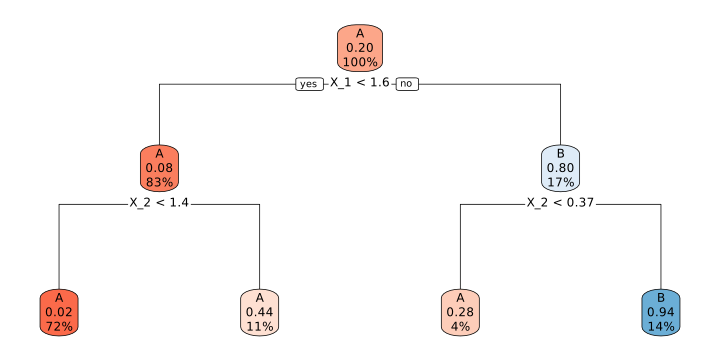
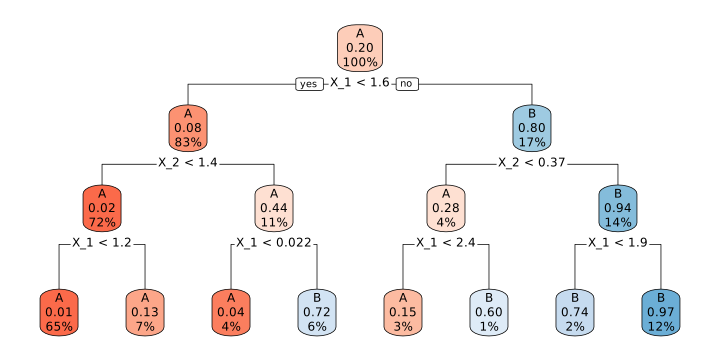
(a) Depth 2: a taller binary tree.
(b) Depth 2: partitioning the feature space again.
Figure 6: Building splits recursively.

Depth 3

Code
depth = 3
ab_fit <- rpart(Y ~ ., data = ab, maxdepth = depth, cp = -Inf)

rpart.plot(ab_fit, box.palette = "RdBu")

p <- ggplot(ab, aes(X_1, X_2, color = Y, fill = Y)) +
  geom_parttree(data = ab_fit, alpha = 0.1, flip = depth == 1) +
  geom_point()
print(p)
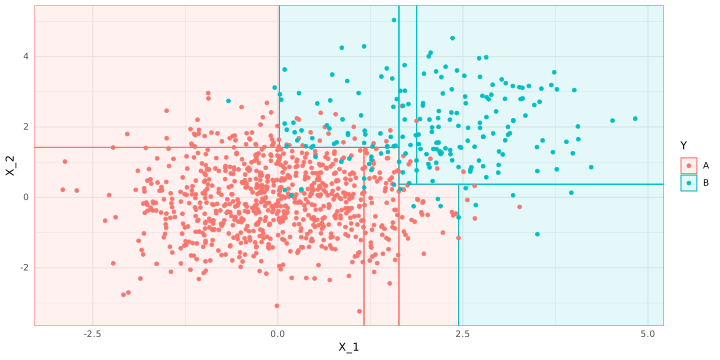
(a) Depth 3: an even taller binary tree.
(b) Depth 3: partitioning the feature space even further.
Figure 7: Building splits recursively.

2.3 Growing the tree

The need of an impurity criterion

Chosing an impurity criterion

We consider the split: \(X_1 <\) 1.64.

Code
ab$split <- ifelse(ab$X_1 < ab_fit$splits[1, 4], "Left", "Right")
dplyr::sample_n(ab, 10)
X_1 X_2 Y split
-1.5017872 1.6803619 A Left
-0.9233743 -0.8534551 A Left
1.5462761 3.3774228 B Left
-0.8320433 1.1174336 A Left
-1.0854224 2.2061932 A Left
0.9922884 0.0171323 A Left
2.6586580 0.3255937 A Right
-0.1726686 -0.2422814 A Left
-0.8874201 -0.9109120 A Left
-1.1729836 -1.6521118 A Left
Code
ab_ct <- table(ab$split, ab$Y) |>
  addmargins() |>
  as.data.frame.matrix()
ab_ct
A B Sum
Left 766 63 829
Right 34 137 171
Sum 800 200 1000
Code
ab_freqs <- ab_ct$Sum / ab_ct$Sum[3]

(ab_probs <- ab_ct / ab_ct$Sum)
A B Sum
Left 0.9240048 0.0759952 1
Right 0.1988304 0.8011696 1
Sum 0.8000000 0.2000000 1
Code
ab_probs$Freq <- ab_freqs
ab_probs$Gini <- 1 - ab_probs$A^2 - ab_probs$B^2
ab_probs
A B Sum Freq Gini
Left 0.9240048 0.0759952 1 0.829 0.1404398
Right 0.1988304 0.8011696 1 0.171 0.3185938
Sum 0.8000000 0.2000000 1 1.000 0.3200000

The total difference in Gini index of this split is:

Code
with(ab_probs, Freq[3] * Gini[3] - Freq[2] * Gini[2] - Freq[1] * Gini[1])
[1] 0.1490959

2.4 Stopping the tree

2.5 Pruning the tree

Why and how pruning?

Code
library(rpart)
library(rpart.plot)

cars_fit <- rpart(Price ~ ., data = cu.summary, minbucket = 1, cp = 0)

rpart.plot(cars_fit, tweak = 2)
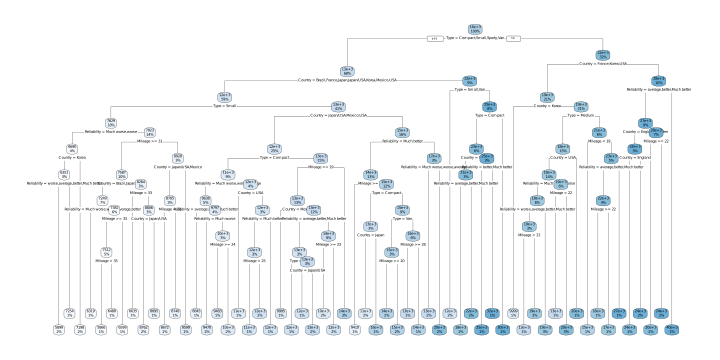
Figure 8: This tree is too complex, it needs to be pruned!
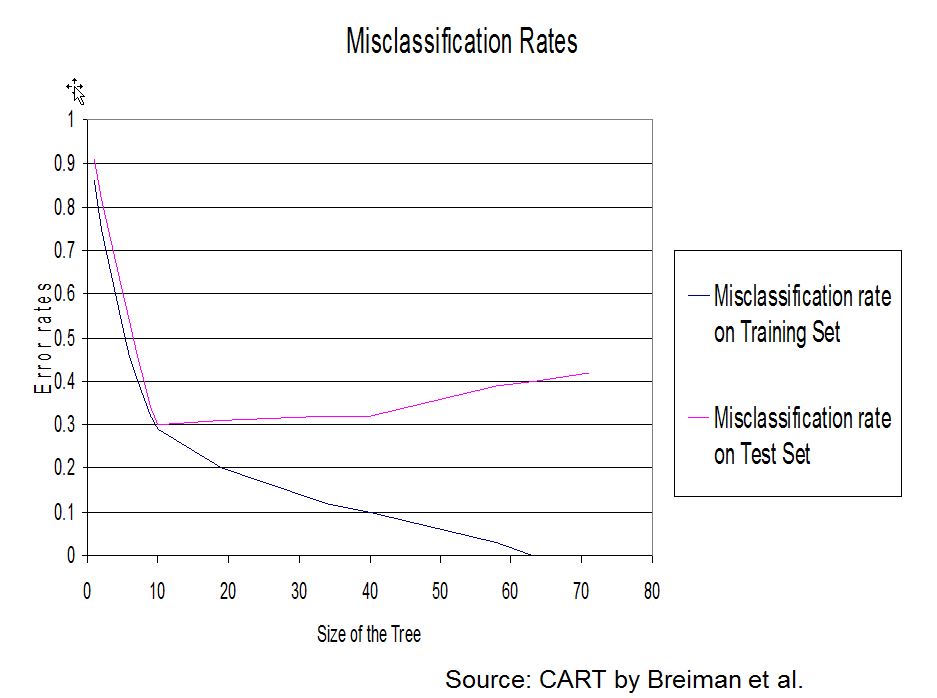
Figure 9: Why pruning?

A penalized criterion

Code
printcp(cars_fit)

Regression tree:
rpart(formula = Price ~ ., data = cu.summary, minbucket = 1, 
    cp = 0)

Variables actually used in tree construction:
[1] Country     Mileage     Reliability Type       

Root node error: 7407472615/117 = 63311732

n= 117 

           CP nsplit rel error  xerror    xstd
1  2.5052e-01      0   1.00000 1.01330 0.15932
2  1.4836e-01      1   0.74948 0.86105 0.16322
3  8.7654e-02      2   0.60112 0.70608 0.14694
4  6.2818e-02      3   0.51347 0.58381 0.10526
5  3.4875e-02      4   0.45065 0.61862 0.12371
6  2.4396e-02      5   0.41577 0.61587 0.12360
7  1.1966e-02      8   0.34259 0.63034 0.12155
8  1.0640e-02     14   0.27079 0.68456 0.14321
9  9.9092e-03     15   0.26015 0.71913 0.14533
10 8.8587e-03     16   0.25024 0.72795 0.14614
11 7.3572e-03     20   0.21480 0.74085 0.15294
12 7.2574e-03     22   0.20009 0.73494 0.15289
13 3.8972e-03     28   0.15655 0.77054 0.15609
14 1.9968e-03     31   0.14334 0.78644 0.15729
15 1.9131e-03     33   0.13935 0.78699 0.15818
16 1.6070e-03     34   0.13744 0.78804 0.15816
17 1.1151e-03     35   0.13583 0.78647 0.15815
18 9.0617e-04     36   0.13471 0.79763 0.15711
19 4.7736e-04     42   0.12928 0.79600 0.15718
20 1.4084e-04     43   0.12880 0.79752 0.15718
21 1.0325e-04     45   0.12852 0.80091 0.15732
22 1.0187e-04     46   0.12841 0.80038 0.15734
23 8.0922e-05     47   0.12831 0.80051 0.15734
24 6.9751e-05     48   0.12823 0.80065 0.15733
25 6.0368e-05     49   0.12816 0.80068 0.15733
26 5.2584e-05     50   0.12810 0.80058 0.15733
27 5.1761e-05     52   0.12800 0.80058 0.15733
28 2.5252e-05     53   0.12794 0.79930 0.15735
29 1.2155e-05     54   0.12792 0.79968 0.15735
30 7.9655e-06     55   0.12791 0.79972 0.15734
31 1.5920e-06     56   0.12790 0.79958 0.15735
32 4.1013e-07     57   0.12790 0.79956 0.15735
33 0.0000e+00     58   0.12790 0.79958 0.15735

Iterative pruning

Code
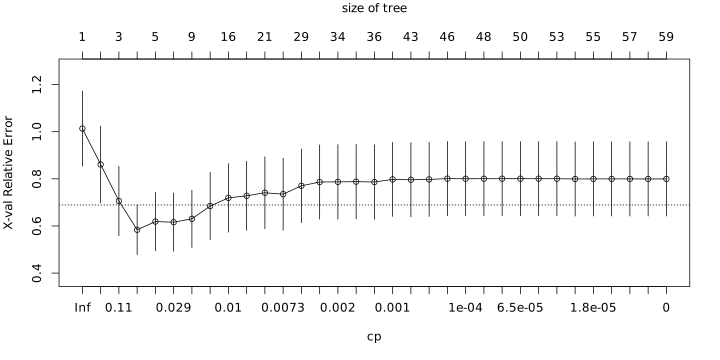
plotcp(cars_fit)

1-SE method.

1-SE method.

Choosing the optimal subtree

Code
cars_fit <- prune(cars_fit, cp = 0.074)
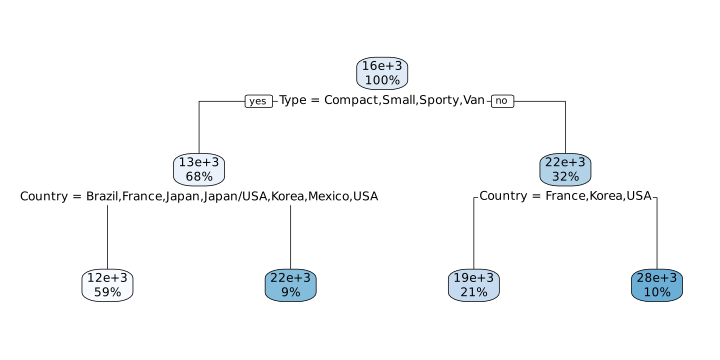
rpart.plot(cars_fit)

The resulting pruned tree.

The resulting pruned tree.

3 Appendix

Code
# Plot
summary(candidates_fit)
Call:
rpart(formula = Res ~ Dip + Test + Exp, data = candidates, method = "class", 
    parms = list(split = "gini"), control = rpart.control(minsplit = 2))
  n= 10 

    CP nsplit rel error xerror      xstd
1 0.80      0       1.0    2.0 0.0000000
2 0.10      1       0.2    0.2 0.1897367
3 0.01      3       0.0    0.6 0.2898275

Variable importance
 Dip Test  Exp 
  67   20   13 

Node number 1: 10 observations,    complexity param=0.8
  predicted class=0  expected loss=0.5  P(node) =1
    class counts:     5     5
   probabilities: 0.500 0.500 
  left son=2 (6 obs) right son=3 (4 obs)
  Primary splits:
      Dip  < 2.5 to the left,  improve=3.3333330, (0 missing)
      Test < 1.5 to the left,  improve=0.5555556, (0 missing)
      Exp  < 3.5 to the left,  improve=0.5555556, (0 missing)

Node number 2: 6 observations,    complexity param=0.1
  predicted class=0  expected loss=0.1666667  P(node) =0.6
    class counts:     5     1
   probabilities: 0.833 0.167 
  left son=4 (4 obs) right son=5 (2 obs)
  Primary splits:
      Exp  < 4.5 to the left,  improve=0.6666667, (0 missing)
      Test < 3.5 to the left,  improve=0.3333333, (0 missing)
      Dip  < 1.5 to the right, improve=0.1666667, (0 missing)

Node number 3: 4 observations
  predicted class=1  expected loss=0  P(node) =0.4
    class counts:     0     4
   probabilities: 0.000 1.000 

Node number 4: 4 observations
  predicted class=0  expected loss=0  P(node) =0.4
    class counts:     4     0
   probabilities: 1.000 0.000 

Node number 5: 2 observations,    complexity param=0.1
  predicted class=0  expected loss=0.5  P(node) =0.2
    class counts:     1     1
   probabilities: 0.500 0.500 
  left son=10 (1 obs) right son=11 (1 obs)
  Primary splits:
      Test < 2.5 to the left,  improve=1, (0 missing)

Node number 10: 1 observations
  predicted class=0  expected loss=0  P(node) =0.1
    class counts:     1     0
   probabilities: 1.000 0.000 

Node number 11: 1 observations
  predicted class=1  expected loss=0  P(node) =0.1
    class counts:     0     1
   probabilities: 0.000 1.000 
Code
# Rules
rpart.rules(candidates_fit)
Res
4 0.00 when Dip < 3 & Exp < 5
10 0.00 when Dip < 3 & Exp >= 5 & Test < 3
11 1.00 when Dip < 3 & Exp >= 5 & Test >= 3
3 1.00 when Dip >= 3
Code
# Prediction
predict(candidates_fit, candidates, type = "class")
 1  2  3  4  5  6  7  8  9 10 
 0  0  1  0  0  1  1  0  1  1 
Levels: 0 1
Code
predict(candidates_fit, candidates, type = "prob")
   0 1
1  1 0
2  1 0
3  0 1
4  1 0
5  1 0
6  0 1
7  0 1
8  1 0
9  0 1
10 0 1
Code
predict(candidates_fit, candidates, type = "matrix")
   [,1] [,2] [,3] [,4] [,5] [,6]
1     1    4    0    1    0  0.4
2     1    4    0    1    0  0.4
3     2    0    1    0    1  0.1
4     1    4    0    1    0  0.4
5     1    4    0    1    0  0.4
6     2    0    4    0    1  0.4
7     2    0    4    0    1  0.4
8     1    1    0    1    0  0.1
9     2    0    4    0    1  0.4
10    2    0    4    0    1  0.4
Code
# confusion table
candidates_predict <- predict(candidates_fit, candidates, type = "vector")
table(candidates_predict, candidates$Res)
                  
candidates_predict 0 1
                 1 5 0
                 2 0 5
Code
# prediction of a new observations
predict(candidates_fit, newdata = data.frame(Dip = c(1, 2, 2), Exp = c(5, 5, 3), Test = c(3, 1, 5)), type = "vector")
1 2 3 
2 1 1 
Code
# Pruning
# print and plot the complexity parameter (cp)
printcp(candidates_fit)

Classification tree:
rpart(formula = Res ~ Dip + Test + Exp, data = candidates, method = "class", 
    parms = list(split = "gini"), control = rpart.control(minsplit = 2))

Variables actually used in tree construction:
[1] Dip  Exp  Test

Root node error: 5/10 = 0.5

n= 10 

    CP nsplit rel error xerror    xstd
1 0.80      0       1.0    2.0 0.00000
2 0.10      1       0.2    0.2 0.18974
3 0.01      3       0.0    0.6 0.28983
Code
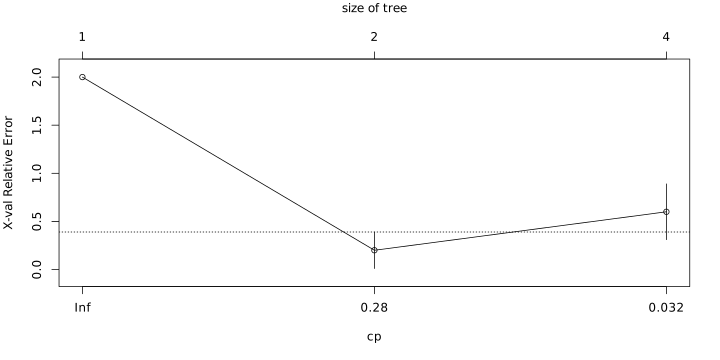
plotcp(candidates_fit)

Code
candidates_fit_prune <- prune(candidates_fit, cp = 0.28)
rpart.plot(candidates_fit_prune)

Code
# Prediction on the pruned data set
predict(candidates_fit_prune, candidates, type = "matrix")
   [,1] [,2] [,3]      [,4]      [,5] [,6]
1     1    5    1 0.8333333 0.1666667  0.6
2     1    5    1 0.8333333 0.1666667  0.6
3     1    5    1 0.8333333 0.1666667  0.6
4     1    5    1 0.8333333 0.1666667  0.6
5     1    5    1 0.8333333 0.1666667  0.6
6     2    0    4 0.0000000 1.0000000  0.4
7     2    0    4 0.0000000 1.0000000  0.4
8     1    5    1 0.8333333 0.1666667  0.6
9     2    0    4 0.0000000 1.0000000  0.4
10    2    0    4 0.0000000 1.0000000  0.4

References

Breiman, Leo, Jerome H. Friedman, Richard A. Olshen, and Charles J. Stone. 1984. Classification And Regression Trees. 1st ed. Routledge. https://doi.org/10.1201/9781315139470.